


Categories
Accounting and Bookkeeping Blog

How To Start Your Accounting Firm with No Experience? + Free Checklist

Summary

Starting your own accounting firm can feel like a big challenge, especially if you don’t have previous experience. But with the right approach, tools, and industry knowledge, it’s entirely possible to build a successful and sustainable business. Whether you aim to provide outsourced bookkeeping and accounting services or manage accounting outsourcing services for small businesses, this guide will help you lay a strong foundation, even if you’re starting from scratch.
If you’re considering the exciting opportunity of initiating an accounting firm, you likely have plenty of questions. How do you build a credible brand without a track record? What key steps should you follow to ensure a successful launch? More importantly, how do you compete in a market where established firms already offer accounting outsourcing services and outsourced bookkeeping solutions?
In this blog, we’ll cover the essential steps to help you get started, from understanding your motivations to structuring your firm and integrating the right technology. By the end, you’ll have a clearer path forward and a free checklist to guide you through those first important steps. With a focus on building your firm efficiently and effectively, even without prior experience, this guide will help you confidently enter the accounting industry.

Understanding Your Motivation and Purpose 01

Before examining the details of launching your accounting firm, it is essential to take a moment to reflect on your motivations. Understanding why you want to embark on this journey will significantly influence your path and help you make informed decisions.
Are you driven by a passion for helping small businesses streamline their finances and achieve their goals? Perhaps you’re inspired by the potential to provide top-tier financial services that empower growing companies to thrive in competitive markets. Identifying your core motivation will not only inform your service offerings but will also serve as a guiding principle in your firm’s mission.

01. Defining Your Long-Term Goals

Establishing clear, long-term goals is vital for the success of your accounting firm. Consider what you envision for your business in the next five to ten years. Do you aspire to expand your firm to include specialized services, such as outsourced bookkeeping and accounting or remote accounting services? Are you aiming to build a team of expert accountants who share your vision? By articulating your long-term goals, you create a roadmap that guides your decision-making processes and helps measure your progress.

02. Creating a Vision Statement

A well-crafted vision statement encapsulates your aspirations and purpose. It serves as a motivational tool for you and your team, providing clarity on what your firm stands for and the impact you want to make in the accounting industry. Your vision might focus on aspects like providing unparalleled customer service, fostering strong relationships with clients, or being a leader in innovative accounting practices. This statement will not only define your firm's identity but also attract clients who resonate with your values.

03. Identifying Your Target Market

Understanding your motivation also extends to defining your target market. Are you inclined to serve local small businesses, freelancers, or specific industries like real estate or technology? Each market has unique financial challenges and opportunities, so aligning your motivations with a specific target demographic will enable you to tailor your services effectively. Conducting market research to assess the needs and preferences of your potential clients can further refine your focus, ensuring that your firm addresses real-world challenges and delivers meaningful solutions.

04. Staying Committed to Your Purpose

As you embark on this journey, remember that challenges will arise. Staying committed to your core motivation and purpose will help you navigate obstacles and maintain your focus. It’s essential to remain adaptable and open to feedback as you grow, while always keeping your initial vision in mind. This dedication not only fuels your personal motivation but also inspires confidence in your clients, fostering long-term relationships built on trust and reliability.

Gaining Industry Knowledge 02

Even without prior experience, you can swiftly build the essential industry knowledge needed to launch a successful accounting firm. In today’s fast-paced and ever-evolving financial landscape, staying informed about accounting trends, regulations, and best practices is crucial for delivering high-quality services to your clients.

01. Embrace Continuous Learning

The accounting profession is marked by constant changes in regulations, technologies, and client expectations. Embracing a mindset of continuous learning is fundamental to staying ahead. Consider enrolling in online courses that cover essential topics such as tax laws, auditing standards, and accounting software. Obtaining relevant certifications, such as CPA (Certified Public Accountant) or CMA (Certified Management Accountant), can also enhance your credibility and open doors to new opportunities.

02. Stay Updated with Industry Trends

Being proactive in your learning journey includes staying updated on industry trends and regulatory changes. Subscribing to reputable accounting publications, such as the Journal of Accountancy or CPA Practice Advisor, will keep you informed about the latest news, case studies, and best practices. Many of these publications also offer newsletters, making it easy to receive timely updates directly in your inbox.

In addition, attending webinars and industry conferences can provide valuable insights and networking opportunities. These events often feature expert speakers who share their knowledge on emerging trends, challenges, and innovative solutions in the accounting field. Participating in professional organizations, such as the American Institute of CPAs (AICPA) or state CPA societies, can further enhance your network and provide access to resources that support your growth.

03. Leverage Technology and Resources

As you build your knowledge base, leverage technology to your advantage. There are numerous resources available online, including forums, podcasts, and blogs dedicated to accounting and finance. Engaging with these platforms can expose you to diverse perspectives and practical tips that can be applied in your firm. Consider joining accounting-focused online communities or social media groups where professionals share insights, answer questions, and support one another.

04. Develop a Knowledge Network

Building a network of knowledgeable contacts within the accounting industry can be incredibly beneficial. Connect with experienced accountants, mentors, or industry peers who can provide guidance and share their experiences. Networking not only allows you to gain insights but also opens doors for collaboration and potential referrals as you establish your firm.

05. Commit to Lifelong Learning

Finally, make a commitment to lifelong learning. The accounting profession demands adaptability, and being open to new knowledge will serve you well in your entrepreneurial journey. Regularly assess your skill set and identify areas for improvement or specialization. By prioritizing education and knowledge, you’ll not only enhance your expertise but also position your firm as a trusted resource for clients seeking comprehensive accounting solutions.

Identifying Your Target Market 03

Defining your niche is a pivotal strategic move that can significantly distinguish your accounting firm from the competition. As you consider the direction of your business, ask yourself: Will you focus on serving small businesses, freelancers, or larger corporations? By honing in on a specific target market, you can better understand their unique challenges and tailor your services to meet their needs effectively.

01. Understanding the Needs of Your Target Market

Every market segment has distinct characteristics and requirements. For instance, small businesses may prioritize affordable outsourced bookkeeping and accounting services that fit their budget, while larger corporations may seek comprehensive financial strategies and in-depth reporting. To accurately identify your target market, conduct thorough market research to uncover the specific needs and pain points of potential clients. Surveys, interviews, and industry reports can provide valuable insights that inform your service offerings and marketing strategies.

Key Services to Offer

Once you’ve established your target market, consider the key services that will resonate with them. Some essential services to contemplate include:

  • Outsourced Bookkeeping and Accounting Services: Many small businesses struggle to maintain accurate financial records. Offering tailored solutions can alleviate their burden and allow them to focus on core operations.
  • Tax Preparation: Tax regulations can be complex and time-consuming for business owners. Providing expert tax preparation services can help clients navigate their obligations while ensuring compliance and maximizing potential deductions.
  • Financial Planning: Helping businesses develop comprehensive financial strategies not only enhances their stability but also positions you as a trusted advisor. This service can include budgeting, forecasting, and investment advice tailored to the specific goals of your clients.
  • Specialized Industry Services: Consider focusing on niche markets, such as real estate, healthcare, or technology. Designed expertise in these areas can set you apart as a go-to resource for clients seeking specialized knowledge.

02. Building Your Reputation as an Expert

A clear niche simplifies your marketing efforts and allows you to concentrate your resources on attracting the right clients. It also enables you to build a solid reputation as an expert in your chosen area. By delivering high-quality services and demonstrating your industry knowledge, you’ll cultivate trust with your clients, making them more likely to refer you to others.

Engaging in thought leadership activities, such as writing articles, giving presentations, or hosting webinars, can further enhance your visibility within your target market. Sharing valuable insights and practical advice showcases your expertise and positions your firm as a reliable resource for prospective clients.

03. Shaping Your Marketing Strategy

Once you've defined your target market and service offerings, adapt your marketing strategy accordingly. Utilize SEO-friendly content on your website and Accounting and Tax blog to attract your ideal clients, focusing on keywords relevant to their needs, such as outsourced accounting services and tax consultancy for small businesses. Leverage social media platforms to connect with potential clients and engage in conversations about industry trends and challenges.

By thoughtfully identifying and understanding your target market, you can create a strong foundation for your accounting firm, ensuring your services align with client needs and establishing a reputation for excellence in your niche.

Take the first step toward building
your accounting firm with confidence.

Contact Unison Globus today to explore how our
expert guidance and resources can help you
succeed in the accounting industry!

Contact

Creating a Solid Business Plan 04

Every successful business starts with a comprehensive plan. A well-structured business plan serves as your roadmap, guiding you through the various stages of establishing and growing your accounting firm. It outlines your mission, details the services you will offer, and presents your financial projections. A solid business plan is not just a document for your reference; it’s a crucial tool for attracting investors and securing funding.

01. Define Your Mission and Vision

At the heart of your business plan should be your mission and vision statements. These articulate what your firm stands for and the impact you aim to make within the accounting industry. Your mission should clearly express your firm's purpose—whether it’s providing exceptional outsourced accounting services or supporting small businesses with tailored financial solutions. Your vision should outline your long-term aspirations, guiding your strategic decisions and inspiring your team.

02. Detail Your Service Offerings

Clearly defining your service offerings is essential for positioning your firm in the marketplace. Highlighting services such as remote bookkeeping solutions, tax preparation, and financial consulting can attract potential clients looking for modern, efficient options. Each service should be accompanied by a description of its benefits, demonstrating how you can meet the specific needs of your target market. For example, explain how your outsourced bookkeeping services can save clients time and reduce stress, allowing them to focus on their core business operations.

03. Market Analysis

A comprehensive market analysis is a critical component of your business plan. This section should include information on industry trends, target demographics, and competitive analysis. Understanding the landscape will help you identify opportunities for growth and areas where your firm can differentiate itself. Analyze competitors’ strengths and weaknesses to find gaps in the market that your firm can fill, such as offering niche services or exceptional customer support.

04. Financial Projections

Financial projections provide a clear picture of your firm’s anticipated performance over the next few years. Include detailed forecasts of your income, expenses, and cash flow. This section is essential for potential investors or lenders, as it demonstrates your understanding of the financial aspects of running a business. Be realistic with your projections, considering factors such as startup costs, pricing strategies, and expected growth. Break down your financial goals into actionable milestones to track your progress effectively.

05. Funding and Investment Strategy

If you plan to seek funding or investment, outline your strategy in this section. Detail how much capital you need, how you intend to use it, and what return investors can expect. Providing a clear funding strategy not only enhances your credibility but also reassures potential investors that you have a solid plan for growth. Highlight your unique value proposition, such as your expertise in outsourced bookkeeping and accounting, to make your firm appealing to investors.

06. Operational Plan

An operational plan outlines the day-to-day functions of your accounting firm. This section should detail your staffing needs, office setup (whether physical or virtual), and technology requirements. Discuss the systems and processes you will implement to ensure efficiency and effectiveness, such as project management tools, accounting software, and client relationship management systems. A well-thought-out operational plan helps demonstrate that you are prepared to handle the complexities of running an accounting firm.

07. Review and Revise

Creating a business plan is not a one-time task; it should be a living document that evolves as your firm grows. Regularly review and revise your plan to reflect changes in the market, shifts in your business strategy, or advancements in technology. Being adaptable and responsive to new information will help you stay ahead of the competition and ensure the long-term success of your firm.

By dedicating the time and effort to create a solid business plan, you lay the groundwork for a successful accounting firm. This document will not only guide your operations but also serve as a powerful tool for attracting clients and securing investments.

Choosing a Legal Structure 05

One of the fundamental decisions you’ll make when starting your accounting firm is choosing the right legal structure. This choice will have significant implications for your business operations, liability exposure, and tax obligations. The three most common legal structures for accounting firms are sole proprietorship, Limited Liability Company (LLC), and partnership. Understanding the pros and cons of each option will help you select the one that aligns best with your business goals and long-term vision.

01. Sole Proprietorship

Operating as a sole proprietorship is the simplest and most common structure for small business owners, particularly for those starting out in the accounting field. This structure allows you to have complete control over your firm and its operations.

Pros:

  • Simplicity: Setting up a sole proprietorship is straightforward and requires minimal paperwork.
  • Full Control: As the sole owner, you make all the decisions and retain all profits.
  • Tax Benefits: Income is reported on your personal tax return, potentially simplifying your tax obligations.

Cons:

  • Unlimited Liability: One of the most significant drawbacks is that you are personally liable for all debts and legal obligations of the business. This means your personal assets could be at risk in the event of a lawsuit or financial difficulties.
  • Limited Growth Potential: Raising capital can be challenging, as you may rely solely on personal funds or loans.
 

02. Limited Liability Company (LLC)

An LLC is a popular choice for many new accounting firms because it provides liability protection while allowing for flexibility in management and taxation.

Pros:

  • Liability Protection: An LLC shields your personal assets from business liabilities, meaning your personal finances are generally protected in case of lawsuits or debts incurred by the business.
  • Tax Flexibility: An LLC can choose to be taxed as a sole proprietorship, partnership, or corporation, providing options to optimize your tax situation.
  • Professional Credibility: Operating as an LLC can enhance your firm's credibility with clients, as it signals a commitment to professionalism.

Cons:

  • Formation Costs: Establishing an LLC typically involves filing fees and additional paperwork compared to a sole proprietorship.
  • Ongoing Requirements: Depending on your state, there may be ongoing compliance requirements, such as annual reports or fees.
 

03. Partnership

If you’re planning to start your accounting firm with one or more partners, forming a partnership can be an effective structure. Partnerships can be general or limited, depending on the roles and liabilities of each partner.

Pros:

  • Shared Resources and Expertise: Partnerships allow you to pool resources, skills, and knowledge, potentially leading to a stronger firm.
  • Simplified Taxation: Like sole proprietorships, partnerships typically do not pay income tax at the business level. Instead, profits and losses are passed over to the partners’ individual tax returns.

Cons:

  • Shared Liability: In a general partnership, all partners share liability for the business's debts and obligations, which can expose personal assets.
  • Potential for Disputes: Partnerships require a strong foundation of trust and clear communication to avoid conflicts that can arise from differing opinions or business decisions.
 

04. Making the Right Choice

When selecting the legal structure for your accounting firm, consider factors such as your business goals, financial situation, and the level of risk you’re willing to take. It’s essential to consult with legal and financial advisors to understand the implications of each structure fully. They can help you evaluate the benefits and drawbacks based on your specific circumstances and guide you in making an informed decision.

Ultimately, the right legal structure will not only protect your personal assets but also position your firm for growth and success. As you move forward, keep in mind that you can always adjust your legal structure as your business evolves, allowing you to remain flexible and responsive to changing circumstances.

Setting Up Your Office 06

As you establish your accounting firm, one of the crucial decisions you’ll face is whether to operate from a physical office or embrace a virtual setup. The choice you make will significantly influence your firm’s operations, costs, and client interactions.

01. Physical Office vs. Virtual Office

Choosing a physical office offers a traditional approach, allowing you to create a dedicated space where you can meet clients, collaborate with team members, and maintain a professional presence. However, this option often comes with higher overhead costs, including rent, utilities, and maintenance.

On the other hand, a virtual office has become increasingly popular among accounting firms, thanks to advancements in technology. This model allows for reduced overhead expenses while providing greater flexibility for both employees and clients. Many firms find that a virtual setup not only enhances work-life balance for their teams but also enables them to attract talent from a wider geographical area.

02. Benefits of a Virtual Office

Once you’ve established your target market, consider the key services that will resonate with them. Some essential services to contemplate include:

Cost Efficiency: Operating virtually can significantly reduce expenses related to office space, utilities, and commuting. These savings can be redirected towards technology investments and marketing efforts.
Flexibility: A virtual office allows you and your team to work from various locations, which can enhance productivity and job satisfaction. This flexibility can also make it easier to accommodate clients' schedules, as meetings can be conducted via video conferencing or phone calls.
Access to Technology: Virtual accounting firms often rely on cloud-based solutions, enabling seamless access to financial data and collaboration tools. This technological integration ensures that your team can work efficiently, regardless of location.

03. Setting Up Your Physical Office

If you choose to establish a physical office, consider the following essential components:

Location: Select a location that is convenient for your target clients and has access to essential amenities, such as parking and public transportation.
Office Equipment: Invest in high-quality office furniture, computers, printers, and other essential equipment to create a functional workspace. Ensure that you have reliable internet connectivity and cybersecurity measures in place to protect sensitive financial information.
Meeting Space: Designate a professional area for client meetings, equipped with the necessary technology for presentations and video conferencing.

04. Creating an Efficient Workflow

Regardless of the office setup you choose, it’s important to create an environment that fosters productivity and collaboration. Implement efficient workflows and utilize project management tools to streamline communication among team members. Cloud-based platforms allow for real-time collaboration, making it easier for your team to share documents and updates.

05. Essential Software and Tools

Equipping your office with the right software is essential for handling accounting tasks effectively. In addition to accounting software like QuickBooks or Xero, consider incorporating tools for:

Client Relationship Management (CRM): A CRM system can help you manage client interactions and track leads, ensuring no opportunities are overlooked.
Project Management: Utilize project management tools like Trello or Asana to organize tasks, set deadlines, and monitor progress.
Communication: Implement secure communication tools such as Slack or Microsoft Teams to facilitate seamless collaboration among team members, regardless of their location.

06. Preparing for Future Growth

As your firm grows, be prepared to adapt your office setup to accommodate changing needs. Whether that means transitioning to a hybrid model or expanding your physical office space, staying flexible will ensure your firm remains agile in the face of growth.

In conclusion, the decision between a physical or virtual office should align with your firm’s vision, budget, and operational goals. By thoughtfully considering your options and equipping your office with the necessary tools, you set a strong foundation for your accounting firm’s success.

Are you ready to transform your vision into reality?

Partner with Unison Globus for personalized support and insights as you establish your accounting firm. Let’s embark on this journey together!

Get in Touch!

    Integrating Technology 07

    In today’s fast-paced business environment, technology is at the heart of modern accounting practices. Integrating cutting-edge accounting software into your firm’s operations is essential for enhancing productivity, improving accuracy, and delivering exceptional service to your clients.

    01. Choosing the Right Accounting Software

    Selecting the right accounting software can significantly impact your firm’s efficiency and effectiveness. Look for solutions that streamline financial management processes and allow for real-time data access. Popular options like QuickBooks and Xero provide a range of features tailored to meet the needs of small to medium-sized businesses.

    • QuickBooks: This user-friendly platform offers robust functionalities for invoicing, expense tracking, payroll management, and financial reporting. Its extensive integrations with other applications make it a versatile choice for accounting firms.
    • Xero: Known for its intuitive interface, Xero provides comprehensive accounting tools, including bank reconciliation, expense claims, and reporting features. Its cloud-based nature allows for collaboration with clients and team members in real time, enhancing communication and efficiency.

    02. Embracing Cloud-Based Solutions

    Transitioning to cloud-based accounting solutions offers numerous advantages for your firm. Cloud technology ensures that your data is securely stored and accessible from anywhere, providing flexibility in how you operate. This is particularly beneficial for remote work environments, enabling you to manage client accounts, access financial reports, and collaborate with your team seamlessly.

    • Scalability: Cloud solutions can easily scale with your business as it grows, accommodating increased data storage needs and additional users without the hassle of upgrading hardware or software.
    • Enhanced Security: Reputable cloud providers invest heavily in security measures, protecting sensitive financial data from unauthorized access and potential breaches. Regular backups and disaster recovery options further safeguard your firm’s information.

    03. Automating Routine Tasks

    Integrating technology also allows you to automate routine accounting tasks, freeing up time for more strategic activities. For example, automated invoicing can ensure timely billing, while recurring payment features simplify the accounts receivable process. Consider implementing tools that automate payroll, tax calculations, and financial reporting, significantly reducing manual errors and saving valuable time.

    04. Utilizing Client Portals

    Establishing client portals is another effective way to integrate technology into your accounting practice. These secure online platforms enable clients to upload documents, access financial reports, and communicate with your team. Providing a seamless client experience enhances customer satisfaction and fosters trust, making your firm more appealing to prospective clients.

    05. Staying Informed About Technological Advances

    The accounting technology landscape is continually evolving, so staying informed about the latest advancements is crucial. Subscribe to industry publications, attend webinars, and participate in conferences to learn about emerging tools and software. Engaging with peers in professional networks can also provide insights into best practices and innovative solutions that enhance your firm’s operations.

    06. Investing in Training and Support

    As you integrate new technology, ensure that you invest in training for yourself and your team. Familiarity with the software and tools will maximize their potential and streamline your firm’s workflows. Consider utilizing online tutorials, vendor-provided training sessions, or industry-specific courses to boost your team’s proficiency.

    By embracing technology and integrating it effectively into your accounting firm, you position yourself for long-term success. The right tools not only enhance productivity and accuracy but also allow your firm to remain agile and adaptable in a rapidly changing industry.

    Marketing Your Firm 08

    To attract clients to your accounting firm, a robust marketing strategy is essential. A well-executed marketing plan not only increases visibility but also establishes your reputation as a trusted provider of outsourced bookkeeping and accounting services. Here are key elements to consider when developing your marketing strategy:

    01. Build a Professional Website

    Your website completes as the digital storefront for your accounting firm. It should clearly highlight your services, expertise, and unique value proposition. Ensure your website is user-friendly and optimized for both desktop and mobile devices. Key elements to include are:

    • Service
      Descriptions:
      Clearly outline the accounting services you offer, such as tax preparation, financial planning, and remote bookkeeping solutions. Be specific about how your services can meet the needs of your target market.
    • Testimonials and Case Studies: Showcase positive feedback from satisfied clients to build trust with potential customers. Real-life examples of how you’ve helped clients achieve their financial goals can make a significant impact.
    • Blog
      Content:
      Regularly updating your website with informative blog posts not only positions you as an expert in the field but also improves your site’s search engine optimization (SEO). Use relevant keywords, such as outsourced accounting services and accounting firm checklist, to attract organic traffic.

    02. Leverage Social Media Platforms

    Social media is a effective tool for increasing visibility and engaging with potential clients. Choose platforms that align with your target market, such as LinkedIn, Facebook, or Instagram. Consider the following strategies:

    • Share Valuable Content: Post articles, tips, and industry news that provide value to your audience. Sharing insights related to accounting trends or tax updates can position you as a knowledgeable resource.
    • Engage with Your Audience: Reply to comments and messages quickly to foster engagement. Participate in significant discussions and groups to connect with potential clients and demonstrate your expertise.
    • Run Targeted Ads: Utilize social media advertising to reach a broader audience. Running targeted ads can help you attract specific demographics that align with your ideal client profile.

    03. Utilize Email Marketing

    Email marketing continues one of the most effective ways to foster leads and maintain relationships with clients. Create a mailing list and send regular newsletters that include:

    • Industry Updates: Share news about changes in tax laws, accounting practices, or industry trends to keep your audience informed.
    • Service Promotions: Highlight your services, special offers, or new service launches to encourage clients to reach out.
    • Client Success Stories: Showcase case studies that illustrate how your services have benefited clients, reinforcing your firm’s value.

    04. Network Offline

    While online marketing is crucial, offline strategies should not be overlooked. Building relationships within your community can significantly boost your firm’s reputation. Consider these approaches:

    • Attend Industry
      Events:
      Participate in accounting conferences, workshops, or local business expos to network with other professionals. These events provide opportunities to meet potential clients and establish valuable connections.
    • Join Professional Organizations: Becoming a member of accounting associations or local chambers of commerce can enhance your credibility and expand your network. Engage in community events to raise awareness of your firm.
    • Collaborate with Local Businesses: Partner with other businesses that complement your services, such as legal firms or financial advisors. Cross-promotions can introduce your firm to new audiences.

    05. Monitor and Adjust Your Strategy

    As you implement your marketing strategy, it’s essential to track your efforts and measure their effectiveness. Use tools like Google Analytics to assess website traffic and user behavior. Monitor your social media engagement and email open rates to understand what resonates with your audience. Based on the data, be prepared to adjust your strategy to optimize results continually.

    In conclusion, a comprehensive marketing strategy that combines online and offline efforts is vital for attracting clients to your accounting firm. By establishing a professional online presence, engaging with your audience, and building relationships within your community, you can create a strong foundation for your firm's growth and success.

    Your accounting firm
    journey starts here!

    Reach out to Unison Globus and discover how our professional expertise in accounting, taxation, and outsourcing can empower you to achieve your business goals!

    Contact

    Building a Client Base 09

    Networking is essential for establishing a robust client base, particularly during the initial stages of your accounting firm. Here are key strategies to consider:
    • Attend Industry Conferences: Participate in relevant events to connect with potential clients and industry peers. These gatherings provide opportunities to showcase your expertise and expand your professional network.
    • Join Professional Groups: Engage with local or national accounting associations to meet other professionals and gain insights into best practices. Membership often offers access to resources and networking events.
    • Ask for Referrals: Don’t hesitate to request referrals from satisfied clients or industry contacts. Word-of-mouth recommendations are powerful and can significantly enhance your credibility.
    • Establish Partnerships: Collaborate with other firms that offer complementary services, such as legal or tax advisory practices. These partnerships can start to common referrals and broaden your client base.
    By actively networking and fostering relationships within the industry, you can effectively build a solid client base for your accounting firm.

    01. Overcoming Challenges

    Starting an accounting firm without prior experience presents a unique set of challenges. However, with the right mindset and strategies, you can effectively navigate these hurdles and build a successful practice. Here are some general challenges and tips for defeating them:

    02. Managing Client Expectations

    One of the most significant challenges you may face is managing client expectations. Clients often expect timely communication, transparency, and exceptional service. To address this, establish clear communication channels from the start and set realistic timelines for deliverables. Regularly update clients on their account status and be proactive in addressing any concerns they may have.

    03. Keeping Up with Industry Changes

    The accounting landscape is constantly evolving, with new regulations, technologies, and best practices emerging regularly. Staying informed is crucial for maintaining your firm's relevance. Commit to continuous learning through online courses, webinars, and industry publications. Joining professional organizations can also provide access to valuable resources and networking opportunities.

    04. Building Confidence and Credibility

    As a new firm owner, you may struggle with self-doubt or a lack of credibility. Overcoming this requires perseverance and a commitment to building your expertise. Leverage testimonials from satisfied clients, share success stories, and engage in thought leadership by writing articles or participating in webinars. Gradually, as you demonstrate your knowledge and skills, you will build trust with both clients and colleagues.

    05. Developing a Strong Support System

    Entrepreneurship can be isolating, so it’s essential to have a solid support system. Seek out mentors or join peer groups to share experiences and advice. Mentors can provide invaluable insights based on their own experiences, while peer groups can offer encouragement and accountability. Engaging with a community of like-minded professionals can help you navigate the challenges of starting and running your firm.

    06. Staying Patient and Resilient

    Success in the accounting industry doesn’t happen overnight. It requires patience, resilience, and a willingness to learn from setbacks. Accept challenges as opportunities for growth, and remember that determination is key. Reflect on your progress regularly, celebrate small wins, and remain focused on your long-term goals. By being prepared for these challenges and implementing strategies to overcome them, you’ll be better equipped to navigate the complexities of starting your accounting firm. With resilience and a commitment to continuous learning, you can turn obstacles into stepping stones on your path to success.

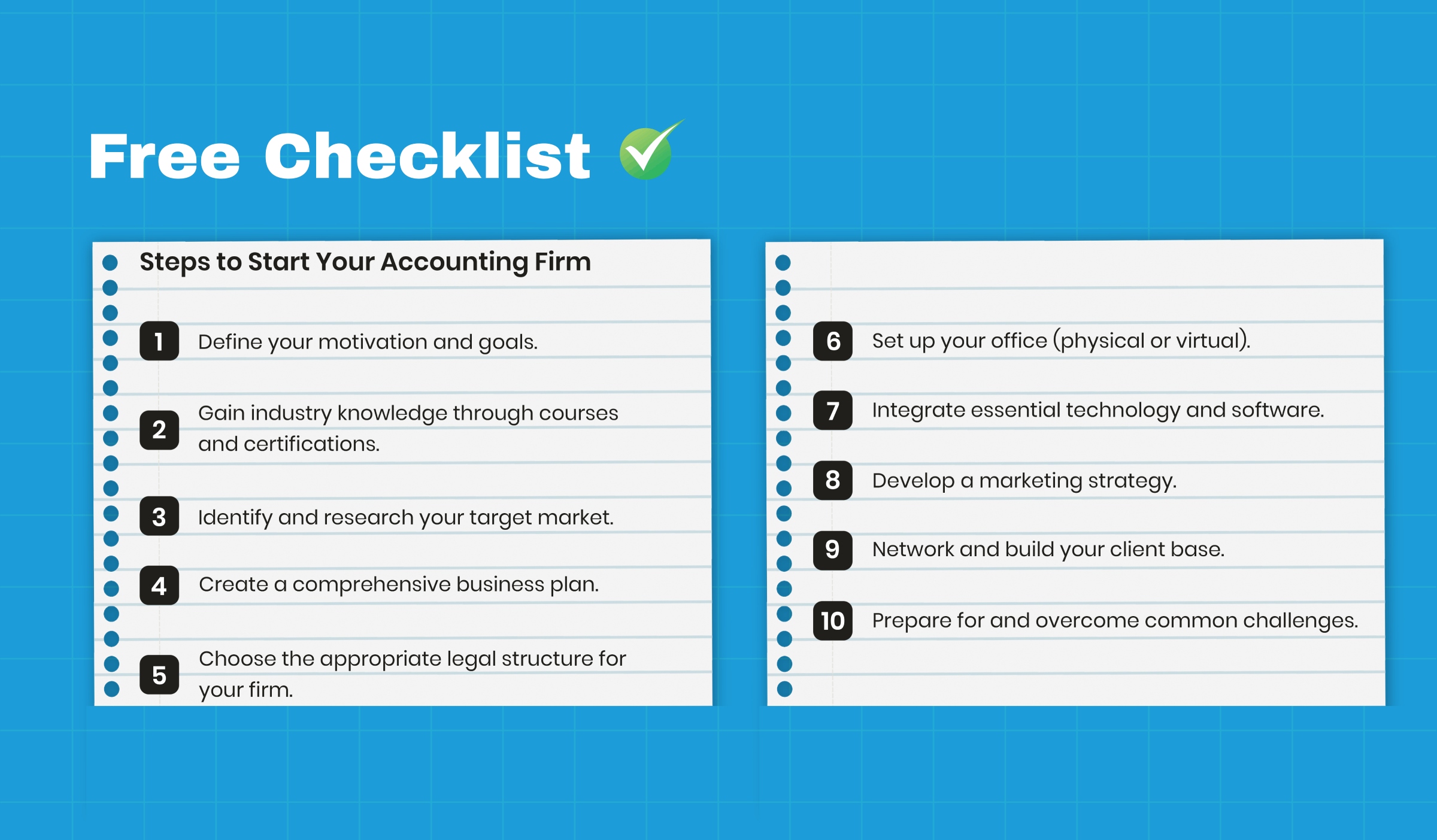
    Free Checklist: Steps to Start Your Accounting Firm
    The benefits of professional accounting services go beyond accuracy. They help small businesses stay compliant, avoid penalties, and make informed financial decisions. By outsourcing, you reduce the burden of in-house accounting while gaining access to expertise and technology solutions that enhance your financial processes.

    01 01. Define Your Motivation and Goals

    Reflect on why you want to start an accounting firm. Establish both short-term and long-term goals to guide your journey and keep you focused.

    02 02. Gain Industry Knowledge Through Courses and Certifications

    Enroll in relevant online courses and pursue certifications to enhance your expertise. This knowledge will build your confidence and credibility in the field.

    03 03. Identify and Research Your Target Market

    Determine the specific clientele you want to serve, such as small businesses, freelancers, or specific industries. Conduct market research to understand their unique needs and preferences.

    04 04. Create a Comprehensive Business Plan

    Develop a detailed business plan outlining your mission, services, market analysis, financial projections, and operational strategies. This file will serve as your roadmap for star.

    05 05. Choose the Appropriate Legal Structure for Your Firm

    Decide on the legal structure that best suits your business model, such as a sole proprietorship, LLC, or partnership. Consider liability protection, tax implications, and operational flexibility.

    06 06. Set Up Your Office (Physical or Virtual)

    Choose a suitable office setup based on your business model. Ensure you have the necessary equipment and technology in place to facilitate efficient operations.

    07 07. Integrate Essential Technology and Software

    Invest in accounting software and tools that enhance productivity and accuracy. Consider cloud-based solutions for better accessibility and collaboration.

    08 08. Develop a Marketing Strategy

    Create a marketing plan that includes online and offline strategies to attract clients. Focus on building a professional website, leveraging social media, and networking within your community.

    09 09. Network and Build Your Client Base

    Attend industry events, join professional groups, and seek referrals to establish connections. Building a solid network is vital for client acquisition and business growth.

    10 10. Prepare for and Overcome Common Challenges

    Anticipate potential challenges you may face and develop strategies to address them. Establish a support system of mentors and peers to help you navigate the ups and downs of entrepreneurship.

    Conclusion

    Starting an accounting firm with no prior experience may seem daunting, but it is entirely achievable with determination, the right resources, and strategic planning. As you embark on this exciting journey, remember that every successful firm begins with a solid foundation built on careful consideration and informed decisions.
    By following this guide and utilizing our free checklist, you can systematically approach each critical step, from defining your motivation to building a robust client base. Each phase of this process is designed to equip you with the knowledge and tools necessary to navigate the challenges of the accounting industry effectively.
    If you’re ready to make your mark in the accounting sector, now is the time to act. Embrace the journey ahead, remain adaptable, and stay committed to your goals. Remember, many successful accounting professionals started just where you are now, facing uncertainty and challenges. Your passion, paired with the strategies outlined in this guide, will position you for success.
    As you move forward, don’t hesitate to seek support from mentors and industry peers who can offer guidance and encouragement along the way. With the right mindset and preparation, you can establish a thriving accounting firm that meets the needs of your clients and stands out in a competitive market.
    Take that first step today and unlock the potential that awaits you in the world of accounting!s
    Categories
    Blog Tax Preparation

    Step by Step Process for Outsourcing Tax Preparation Services to Unison Globus

    Outsourcing tax preparation can be a strategic move to enhance efficiency, reduce costs, and focus on core business operations. At Unison Globus, we offer comprehensive outsourcing solutions tailored to CPA and accounting firms’ needs. Here’s a detailed guide to our step-by-step process for outsourcing tax preparation services to Unison Globus.

    Pathway to Effective Tax Preparation Outsourcing

    01 01. Initial Engagement – Laying the Foundation

    Our journey begins with a comprehensive engagement proposal. This document outlines the services, terms, and other vital information, providing a clear understanding of what to expect from our partnership. Our team will then request last year’s paperwork, including signed copies, tax returns, and key documents, ensuring we have all the necessary details to get started.

    02 02. Software Assessment – Choosing the Right Billing Solutions

    We know that every business has unique needs. That’s why we take the time to assess the most suitable billing software for your operations. Whether you’re using a current system or require a fresh start, we ensure your business processes remain efficient and user-friendly.

    03 03. Agreement and Documentation – Finalizing the Partnership

    Once you review the terms, we follow up to finalize and sign the agreement. For new entities, we determine incorporation requirements and gather additional documentation to confirm operational status. This step guarantees compliance and sets the stage for a seamless tax preparation experience.

    04 04. Data Transfer and Integration – Seamless Transition to Our Systems

    If you’re migrating from an existing software, our experts handle the transfer of data into the new system, minimizing operational disruptions. We then select and configure the best-fit accounting and tax software tailored to your business’s needs, setting up essential features like a new chart of accounts.

    05 05. Formalizing Contact Information – Ensuring Effective Communication

    We collect your contact details and mailing address to formalize and authorize our approach. This step is crucial for maintaining transparency and effective communication throughout our engagement.

    06 06. Comprehensive Onboarding – Our Checklist for Success

    Client onboarding is a pivotal stage for operational efficiency. To ensure a smooth process, we follow a comprehensive checklist that includes:
    • Planning the transition: Aligning the process with your business goals.
    • System upgrades: Upgrading systems to meet your specific requirements.
    • Data collection: Facilitating a seamless transition by gathering essential information.
    • Secure information transfers: Implementing safe data transfers for peace of mind.
    • Policy development: Establishing policies to guide our engagement effectively.
    • Stakeholder communication: Keeping key players informed and involved.
    • Process implementation: Transitioning operations smoothly without disruption.
    • Legal compliance: Ensuring adherence to regulations at every step.

    07 07. Transition Strategy Audit – Reviewing and Refining the Process

    To ensure everything is on track, we conduct a thorough audit and analysis of the transition strategy. Our team identifies potential issues and recommends corrective measures to ensure a smooth transition.

    08 08. Post-Engagement Support – Ongoing Excellence and Follow-Up

    Our commitment to excellence doesn’t end once the transition is complete. We assist with post-engagement reviews, conduct follow-up meetings, and maintain transparency and accountability to ensure your ongoing satisfaction.

    Ready to Simplify Your Tax Preparation?

    Connect with us today to explore how we can tailor
    our services to meet your unique needs.

    Contact

    What to Expect from Your Side: Easy and Protected Onboarding

    We value our clients’ time and security, making your part in the onboarding process simple yet effective:
    Provide Essential Documents Gather and securely share necessary documents, such as previous tax returns and incorporation records.
    Collaborate on Software Selection Share preferences regarding billing and accounting software to help us tailor the best solutions for your needs.
    Clear CommunicationMaintain open communication to ensure a smooth exchange of information.
    Adopt the New Systems Integrate and familiarize yourself with the new accounting systems we put in place, equipping your business for success.

    Flexible Engagement Models and the Unison Globus Workflow

    Step 1: Choose Your Engagement Model – Flexibility to Suit Your Needs

    At Unison Globus, we understand that every firm has unique requirements. That’s why we offer two flexible models for outsourcing tax preparation services:

    1. Per Return Model

    This model is ideal for seasonal support when you're unsure about the fixed number of hours needed. You can outsource a specific number of tax returns as and when you need assistance.

    • Pricing: We charge a fixed base price for the initial hours. If the preparation takes longer, an hourly rate applies for the extra hours.

    2. Hire a Tax Preparer

    For a more dedicated approach, this model allows you to hire a remote tax preparer who works exclusively for you, mirroring your in-house staff. We offer three variations to suit your needs:

    • Full-Time: A tax preparer works 8 hours daily, providing:
      • The opportunity to interview and select the remote staff before hiring.
      • Daily timesheet submissions for full transparency.
      • Constant monitoring to prevent errors and ensure quality.
      • Full control over task allocation.
    • Part-Time: A part-time tax preparer works 4 hours daily, offering the same benefits as full-time but with reduced hours.
    • Hourly: For those uncertain about workload, this model charges only for the hours worked by the remote tax preparer, making it a cost-effective and flexible solution.

    Step 2: Choose the Tax Preparer That Fits Your Firm’s Needs – Tailored Expertise for You

    One of the biggest advantages of outsourcing with Unison Globus is the ability to handpick the tax preparer you want. We provide you with a selection of CVs for review based on your criteria, such as core tax expertise, industry-specific knowledge, software experience, or extensive training under tax reviewers.

    Benefits of Choosing Your Tax Preparer:

    • Core Tax Expertise: Select a remote staff member with expertise aligned with your clients' needs.
    • Industry Knowledge: Choose a tax expert experienced in your specific industry.
    • Software Proficiency: opt for a remote staff proficient in the tax software you use.
    • Experience: Hire professionals trained under seasoned tax reviewers for 5+ years.

    Step 3: Conduct a 1-on-1 Interview – Ensuring the Right Fit for Your Firm

    After selecting potential candidates, conduct a 1-on-1 interview to assess their skills. Ask theoretical and practical questions to evaluate their expertise, ensuring they meet your firm’s standards before onboarding.

    Step 4: Welcome the Tax Preparer Onboard – Seamless Integration into Your Team

    Once finalized, the tax preparer joins your team within 24-48 hours. They begin by securely collecting documents through a remote access portal. No extra training is needed as our tax preparers are seasoned professionals experienced in multiple tax seasons.

    Take the first step toward a hassle-free tax preparation journey now!

    Unlock the full potential of your firm's operations with Unison Globus's expert outsourcing solutions. Our flexible engagement models and dedicated team of tax professionals are here to streamline your processes, ensuring compliance and peace of mind.

    Get in Touch!

      Unison Globus: Streamlining Your
      Tax and Accounting Solutions

      Our diverse range of outsourcing CPA services caters to every aspect of your tax and accounting needs:
      Our services are delivered with a commitment to data security, quality, and transparency, ensuring peace of mind for your firm.

      The Process Workflow at Unison Globus

      We prioritize security, efficiency, and seamless outsourcing with our workflow’s three key aspects:

      1. Access

      • Cloud: Our remote staff securely logs into your software to access client documents.
      • RDP Access: Staff connects to your computer via a remote desktop connection, logging out after the work is done.

      2. Communication

      • Immediate Response: Using tools like Email, Skype, Slack, Microsoft Teams, and SharePoint, our staff ensures prompt communication and 24-hour turnaround time due to our Indian Time Zone advantage.

      3. Task Monitoring

      • Timesheet: Daily timesheets provide complete visibility of the remote staff's work.
      • Review Meetings: Regular meetings allow you to assign further tasks, resolve queries, and monitor progress.

      Why Choose Unison Globus for Your Outsourcing Needs?

      Unison Globus offers tailored outsourcing services designed to streamline operations, reduce costs, and ensure compliance. Our flexible models, expert team, and transparent workflow make us your go-to partner for a hassle-free outsourcing experience.

      Let’s Get Started on
      Your Outsourcing Journey!

      Make your tax preparation process
      more efficient, secure, and
      cost-effective with Unison Globus.

      Whether you need seasonal support or a full-time tax preparer, we have the right solution for you.

      Contact us now to discuss your requirements and discover how our tailored outsourcing services can benefit your firm.

      Optimize your tax preparation process—partner with Unison Globus today! Contact

      Tips for a Successful Outsourcing Experience with Unison Globus

      01 01. Organize Your Documents

      Before starting the outsourcing process, gather all the necessary tax-related documents, including previous year tax returns, financial statements, and other relevant paperwork. Having these documents ready will facilitate a smoother transition.

      02 02. Define Clear Objectives:

      Outline what you aim to achieve by outsourcing your tax preparation. Whether it’s cost-saving, improved accuracy, or handling a seasonal workload, clear objectives will help tailor the outsourcing process to meet your business needs effectively.

      03 03. Communicate Your Preferences:

      Share your preferences regarding billing software, accounting processes, and reporting formats. This will allow Unison Globus to align their services with your existing workflows, ensuring seamless integration.

      04 04. Select the Right Engagement Model

      Assess your current workload and future projections to choose the most suitable engagement model. If you anticipate seasonal spikes, the Per Return model may work best. For continuous support, consider hiring a full-time or part-time tax preparer.

      05 05. Be Open to a Flexible Approach

      Outsourcing offers flexibility, so be open to adjusting your engagement model as your business needs evolve. Regularly assess the outsourced tasks to ensure they align with your firm’s goals and make changes if necessary.

      06 06. Take Advantage of the Interview Process

      Use the 1-on-1 interview step to thoroughly assess the tax preparer’s expertise and compatibility with your firm. Ask relevant theoretical and practical questions to gauge their knowledge and experience in your specific industry.

      07 07. Set Clear Communication Channels

      Establish preferred communication tools, such as Email, Skype, or Microsoft Teams, to stay connected with the remote tax preparer. Regular communication ensures alignment and quick resolution of any queries.

      08 08. Review Timesheets Regularly

      Monitor the timesheets provided by Unison Globus’s remote staff. This will give you insights into their work progress, helping you make informed decisions on workload allocation and task prioritization.

      09 09. Utilize the Secure Access System

      Rest assured that Unison Globus follows strict security measures. Use the secure access portals and cloud login systems recommended by their team to protect your clients’ sensitive financial information.

      10 10. Schedule Regular Review Meetings

      Set up periodic meetings to review the progress and provide feedback. These sessions are an excellent opportunity to discuss any adjustments, address concerns, and align on upcoming tasks.

      11 11. Stay Involved

      Even though the tax preparation tasks are outsourced, staying involved in the process helps maintain control over your operations and ensures that the service meets your standards.

      Ready to get started?

      Connect with Unison Globus today and take the first step toward an expertly managed tax preparation process.
      Categories
      Accounting and Bookkeeping Blog Management Accounting Payroll Tax Preparation

      Useful List of Accounting Services for Small Business in 2024

      As small business owners, wearing many hats is inevitable. However, juggling essential tasks like accounting alongside day-to-day business operations can become overwhelming. The relevance of professional accounting services remains unchanged for businesses of all sizes, but for small businesses, efficient accounting is crucial for sustaining growth and compliance.
      While outsourcing accounting might feel like a leap, it is a cost-effective solution for small businesses that lack the resources to hire full-time professionals. Unison Globus offers tailored solutions to simplify your accounting needs, helping you stay focused on your business goals. Below is a list of critical accounting services your small business can benefit from in 2024.

      Detailed Descriptions of Each Service

      01 01. Bookkeeping Services

      Precise bookkeeping is the backbone of any business’s financial strength. It involves systematically recording financial transactions to ensure smooth accounting processes. Partnering with outsourced bookkeeping services ensures your records are kept up-to-date, helping you stay on track with cash flow and financial planning. By engaging with expert accountants and bookkeepers, you gain access to professionals who can manage your books using advanced software, ensuring efficiency and accuracy.

      02 02. Monthly Accounting Activities

      Monthly accounting reviews provide valuable insights into your financial standing. These reviews help detect early issues and enable informed decision-making for the future. Small business owners can benefit from accounting outsourcing services USA, ensuring that timely reports are generated and monthly financial statements prepared by experienced professionals.

      03 03. Tax Preparation and Filing

      Staying compliant with tax regulations is non-negotiable for small businesses. An understanding of common tax deductions and proper filing ensures you avoid penalties and save money. Engaging outsourced CPA services offers the expertise needed to manage tax-related obligations efficiently. Whether it’s navigating tax season or preparing returns, outsourced accounting services USA can help streamline the process.

      04 04. Payroll Processing

      Payroll management is often more complex than it appears. Ensuring on-time payments, compliance with tax regulations, and accurate payroll reporting are vital. Outsourced bookkeeping & accounting services help manage payroll smoothly, allowing you to focus on core business activities while ensuring compliance and proper tax filing.

      05 05. Financial Planning and Analysis

      Strategic financial planning plays a pivotal role in guiding business growth. With financial planning and analysis, businesses can make data-driven decisions based on in-depth financial insights. For example, using remote accounting services can provide regular financial forecasts and analyses that align with your business goals, aiding in long-term sustainability.

      06 06. Outsourced CPA Services

      Hiring a full-time CPA may not be feasible for small businesses due to cost. However, outsourcing to a bookkeeping outsourcing firm or CPA allows you to access expert advice at a fraction of the cost. These services provide advisory support, periodic reviews, and assistance in making strategic financial decisions.

      07 07. Forensic Accounting Needs

      Protecting your business from fraud is essential. Forensic accounting helps detect discrepancies and misstatements, identifying potential fraud early. By engaging with outsourced accounting services, small businesses can implement necessary safeguards and maintain financial integrity.

      Looking for Expert Accounting Solutions?

      Partner with Unison Globus to streamline your accounting needs.

      Contact

      Benefits of Using Professional Accounting Services

      The benefits of professional accounting services go beyond accuracy. They help small businesses stay compliant, avoid penalties, and make informed financial decisions. By outsourcing, you reduce the burden of in-house accounting while gaining access to expertise and technology solutions that enhance your financial processes.

      Comparison of In-House vs. Outsourced Accounting

      While in-house accounting provides control, it can be resource-intensive and costly for small businesses. Outsourced bookkeeping solutions offer flexibility, cost savings, and access to expert accountants without the overheads of full-time staff. Additionally, outsourcing allows small businesses to scale operations as needed without compromising quality.
      Aspect In-House Accounting Outsourced Accounting
      Cost Requires full-time salaries, benefits, and office space, leading to higher overheads. More cost-effective, with flexible payment options based on the scope of services. No additional costs for office space or employee benefits.
      Control Full control over accounting processes with direct oversight of staff. Access to experienced professionals, with the option to customize services. Regular updates and reports maintain transparency
      Scalability Limited by the capacity of the in-house team; hiring more staff can be expensive and time-consuming. Easily scalable to meet the changing needs of the business without hiring new employees. Can expand or reduce services as required.
      Expertise Limited to the knowledge and experience of the in-house staff. Ongoing training may be needed. Access to a wide range of experts with specialized skills in accounting, tax, and bookkeeping, who stay up-to-date with industry trends.
      Technology Integration May require significant investment in software and tools, plus training for staff. Outsourced firms use the latest accounting technology and software, with no additional costs for setup or training.
      Compliance & Regulation In-house teams may need regular updates and training to stay compliant with changing regulations. Outsourced providers ensure compliance with the latest tax and financial regulations, reducing the risk of penalties.
      Time Commitment Business owners need to dedicate time to managing and overseeing the accounting team. Outsourcing frees up time for business owners to focus on core activities while receiving timely updates on financial matters.
      Flexibility In-house accounting teams may not be able to adapt quickly to changing business needs. Outsourced accounting provides flexibility to adjust services based on seasonal or market changes.
      Hiring & Training Requires time and resources to hire, train, and retain qualified accountants. No need to hire or train. Outsourced firms provide a ready-made team of professionals with experience in your industry.

      Tips for Choosing the Right Accounting Service

      Selecting the right accounting partner is essential. Look for bookkeeping firms that specialize in small business needs, offer competitive pricing, and have a strong track record. A good partner will provide personalized services, from outsourced bookkeeping for CPAs to payroll management, ensuring all aspects of your accounting are covered.

      Pro Tips for Choosing the Right Accounting Service

      Specialization in Your Industry Choose a firm that understands the unique challenges and requirements of your industry. Specialized accounting services ensure they are well-versed in the specific tax laws, compliance regulations, and financial reporting standards that apply to your business.
      Scalable Solutions As your business expands, your accounting needs will advance. Look for firms that offer scalable accounting solutions—from basic bookkeeping to advanced financial analysis—so you can easily adjust the level of service based on your business’s growth without switching providers.
      Technology-Driven ServicesOpt for firms that integrate cloud-based accounting software and use the latest technology for secure, real-time access to your financial data. This will help you stay updated with your accounting reports, access your data on the go, and ensure your business uses cutting-edge solutions for better financial management.
      Transparent Pricing Structure Ensure the accounting service provides a transparent pricing model with no hidden fees. Whether they offer hourly rates, fixed fees, or package deals, it’s crucial to understand what’s included in the service and how additional costs may arise as your needs grow.
      Proven Track Record & Reputation Verify the firm’s experience by looking into their track record with businesses similar to yours. Client testimonials, reviews, and case studies can provide insights into how well they handle small business accounting needs and their success in delivering results.
      Certifications & Qualifications Ensure that the accountants you work with have the proper certifications (e.g., CPAs, CAs, or EAs). Certified professionals provide assurance that they are held to high standards of competency and ethics, which is crucial for accurate reporting and regulatory compliance.
      Comprehensive Service Offerings Choose a firm that offers a full suite of accounting services, including payroll management, tax preparation, bookkeeping, and financial advisory services. This ensures all aspects of your accounting are covered, reducing the need for multiple service providers and streamlining your operations.
      Communication & Responsiveness Look for a partner who is responsive and communicative. Timely responses, regular check-ins, and easy access to financial reports are critical. A good accounting partner should feel like an extension of your team, keeping you updated and informed at all times.
      Data Security Measures With increasing concerns around data breaches, ensure your accounting partner follows strict data security protocols to protect sensitive financial information. Opt for firms that use encrypted systems and have robust cybersecurity measures in place.
      Proactive Financial GuidanceA good accounting service doesn’t just handle your numbers; they act as strategic advisors for your business. Look for firms that offer proactive guidance, helping you identify cost-saving opportunities, improve profitability, and plan for future growth with data-driven insights.

      Industry-Specific Accounting Services

      Different industries have unique accounting requirements. Unison Globus offers specialized services across various sectors, from tech startups to e-commerce and manufacturing. Each industry benefits from tailored accounting services that address specific compliance and reporting needs.
      Finance & Insurance
      Real Estate, Rental & Leasing
      Advisory & Financial Service
      Research and Development
      Arts & Entertainment
      For more details, visit our Market Page.

      Technology Integration in Accounting

      Modern accounting is driven by technology. Outsourced accounting services incorporate advanced software and tools to enhance data security, improve reporting accuracy, and streamline processes. Investing in technology-driven accounting and bookkeeping outsourcing services ensures your business stays ahead in an increasingly digital world.

      At Unison Globus

      From bookkeeping to tax preparation, we offer scalable and fitted services to assistance your business thrives.

      Connect with us today to get started!

      Get in Touch!

        Common Accounting Mistakes to Avoid

        Small businesses often make common accounting errors such as improper record-keeping, missing tax deadlines, and poor cash flow management. Engaging with bookkeeping service providers ensures you avoid these pitfalls. Professional accountants help keep your financial records in order, ensuring timely reporting and filing.
        Common Accounting Mistakes to Avoid:
        Inaccurate Record-Keeping: Keep all financial records up to date and organized to prevent discrepancies.
        Tip: Use cloud-based accounting software for real-time updates.
        Not Reconciling Accounts: Regularly reconcile your bank accounts to catch errors or fraud early.
        Tip: Schedule monthly reconciliations with professional bookkeepers.
        Missing Tax Deadlines: Ensure timely filing to avoid penalties.
        Tip: Automate tax reminders and rely on professional accountants to handle tax compliance.
        Poor Cash Flow Management: Monitor your cash flow regularly to avoid liquidity issues.
        Tip: Create monthly cash flow forecasts with the help of expert accountants.
        Mixing Personal and Business Finances: Always keep personal and business accounts separate.
        Tip: Set up dedicated business accounts and track every transaction accurately.

        How to Maximize the Value of Accounting Services

        To get the most from your accounting services, ensure regular communication with your accounting partner. Regular financial reviews, budget adjustments, and strategic planning sessions are essential. Outsource bookkeeping and accounting services that offer tailored advice and proactive solutions to enhance business growth.

        On the whole

        Accounting plays a crucial role in the success of any small business. With the right outsourced accounting services USA, you can streamline financial operations, stay compliant, and make better business decisions. Unison Globus is here to support your journey with customized, cost-effective accounting solutions. Our outsourced bookkeeping services and expert CPAs can help you maintain financial health, grow your business, and stay ahead in 2024. Contact us today to learn how we can assist your business in achieving its goals!

        FAQs on Accounting Services for Small Businesses

        01 01. What is the difference between bookkeeping and accounting?

        Bookkeeping involves recording daily financial transactions, such as sales and expenses. Accounting includes interpreting, classifying, analyzing, reporting, and summarizing financial data to provide deeper insights into your business.

        Read more: https://unison.web-stage.in/accounting-vs-bookkeeping-infographic/

        02 02. Why should I separate my business and personal finances?

        Separating business and personal finances simplifies tax preparation, protects personal assets from business liabilities, and makes it easier to track business expenses and cash flow. It’s a fundamental step in maintaining financial clarity and compliance.

        03 03. How often should I review my financial statements?

        Reviewing your financial statements monthly ensures accuracy and enables informed business decisions. Regular reviews allow you to identify trends, adjust strategies, and address any issues early on.

        04 04. What are the benefits of outsourcing accounting services?

        Outsourcing saves time, reduces costs, and provides access to expert advice, ensuring tax compliance and accurate financial management. It allows business owners to focus on growth while experienced professionals handle the accounting workload.

        05 05. How can cloud-based accounting services benefit my business?

        Cloud-based accounting services offer anytime, anywhere access to real-time financial data, improved collaboration, enhanced data security, and cost savings. These services integrate advanced technology, enabling better financial decision-making.

        06 06. What should I look for when choosing an accounting service provider?

        Look for a provider with industry-specific expertise, a range of scalable services, advanced technology integration, and a strong reputation for communication. A good accounting partner will tailor services to your business needs and be responsive and transparent.

        07 07. Can I prepare my company’s taxes myself?

        While possible, hiring a professional accountant ensures accuracy, maximizes deductions, and keeps you compliant with ever-changing tax laws. Accountants provide valuable strategic advice that can improve financial outcomes.

        08 08. How much does it cost to hire an accountant?

        The cost varies on the services you expect, the complexity of your business, and the accountant’s experience. Always compare pricing and services to find an accounting partner that fits your budget and delivers value.

        Connect with Unison Globus

        At Unison Globus, we specialize in helping small businesses navigate their accounting needs with expert solutions, scalability, and advanced technology integration. Whether you need bookkeeping, tax services, or financial analysis, our team is here to support your growth with personalized services. Contact us today to learn how Unison Globus can be your trusted accounting partner!
        Categories
        Accounting Blog

        2024 and Beyond: The Top Accounting Trends to Watch

        The accounting landscape is undergoing significant transformation, driven by advancements in technology and shifts in business practices. For CPAs, EAs, and accounting firms across the United States, staying abreast of these changes is more than just a necessity—it’s an opportunity to enhance services and streamline operations. As we look toward 2024, several key trends are set to shape the future of accounting, from the rise of outsourced bookkeeping and accounting services in the USA to the integration of cutting-edge technologies.

        Artificial Intelligence (AI) & Machine Learning (ML)

        AI and ML are no longer just emerging technologies; they have become essential tools in the accounting sector, significantly impacting how firms operate. According to recent studies, over 60% of large accounting firms in the United States are already utilizing AI to enhance their services. This trend is rapidly expanding to small and medium-sized firms, with adoption rates expected to increase by 30% over the next two years.
        By automating routine tasks such as data entry, reconciliation, and invoice processing, AI can reduce the time spent on these activities by up to 80%. This automation not only saves time but also minimizes human error, which accounts for nearly 75% of data entry mistakes in traditional accounting practices. As a result, CPAs and EAs can reallocate their time to more strategic activities, such as advisory services and client relationship management, thereby increasing their value to clients.
        Firms offering outsourced accounting services and outsourced bookkeeping for CPAs are leveraging AI technologies to deliver more precise and efficient services. For instance, AI-driven analytics enable firms to analyze vast amounts of financial data quickly, providing deeper insights that can be used for better financial forecasting and risk assessment. This capability is particularly valuable for CPAs, as clients have indicated a preference for accountants who can provide predictive insights and strategic guidance based on data-driven analysis.
        Moreover, AI can significantly enhance client satisfaction and trust. According to a survey by the American Institute of CPAs (AICPA), clients expressed greater confidence in firms that use AI and advanced technologies, as these tools reduce the likelihood of errors and ensure more accurate financial reporting. This trust translates into higher client retention rates, with firms that utilize AI reporting to increase in client loyalty compared to those that do not.

        Data and Analytics: Transforming Accounting Practices

        Data analytics is revolutionizing the accounting profession, enabling firms to make smarter, more informed decisions. For US-based CPAs, EAs, and accounting firms, leveraging data analytics trends in accounting means turning vast amounts of financial data into actionable insights. Advanced accounting and bookkeeping software allows firms to quickly analyze large datasets, uncovering patterns that help predict cash flows, assess risks, and optimize strategies.
        Firms specializing in outsourced bookkeeping and accounting for American CPAs can significantly benefit from big data analytics in accounting by providing deeper insights into financial trends. This data-driven approach enhances audit accuracy, improves client trust, and allows for more proactive, strategic advice. With real-time data analytics, firms can deliver timely financial insights, staying ahead of client needs in a rapidly changing environment.
        Embracing these data analytics trends not only boosts efficiency but also positions accounting firms as innovative leaders. By adopting big data tools, firms can enhance their service offerings, maintain robust data security, and build stronger client relationships.

        Cloud-Based Accounting: Enhancing Efficiency and Security

        The shift to cloud-based accounting solutions is revolutionizing how accounting firms operate. For US-based CPAs, EAs, and firms providing accounting outsourcing services, cloud technology offers unparalleled benefits, including remote access, enhanced collaboration, and real-time updates. These platforms enable seamless integration of client data, streamlining processes and significantly reducing the time required for financial reporting.
        Cloud-based systems also enhance transparency, allowing accountants to provide clients with up-to-date financial information at any time. This real-time access is crucial for firms that specialize in outsourced accounting and bookkeeping services, enabling them to deliver timely and accurate insights that drive better decision-making.
        Security is a primary concern for all accounting firms, and cloud providers prioritize robust protection against data breaches and unauthorized access. By adopting cloud-based solutions, firms can ensure data security while benefiting from scalable resources that adapt to changing needs. This shift not only improves operational efficiency but also positions firms as forward-thinking, tech-savvy partners in the eyes of their clients.

        Remote Work: Adapting to a New Era in Accounting

        The rise of remote work is reshaping the accounting industry, offering flexibility and access to a global talent pool. For US-based CPAs, EAs, and firms specializing in outsourcing services for CPA firms and CPA firm outsourcing solutions, remote work solutions like cloud accounting software and virtual communication platforms are game-changers. These tools enable firms to deliver high-quality services from anywhere, eliminating the need for a physical office.
        By embracing remote work, firms can reduce overhead costs while maintaining strong client relationships and efficient workflows. This adaptability not only enhances service delivery but also positions firms as innovative and resilient, ready to meet the challenges of a dynamic business environment.

        Blockchain Technology: Redefining Accounting Integrity and Security

        Blockchain technology is more than just a buzzword—it’s reshaping how financial transactions are recorded and verified. With its unparalleled transparency and security, blockchain has the potential to significantly impact accounting practices. For firms specializing in outsourced accounting and bookkeeping services, the impact of blockchain on accounting practices is profound, offering a way to ensure the accuracy and integrity of financial records.
        By using blockchain for secure financial transactions, firms can reduce the risk of fraud and enhance compliance with regulatory standards. This technology creates a tamper-proof ledger of all financial activities, making it easier to audit and verify transactions. For accounting firms, embracing blockchain means adopting a tool that not only protects client data but also builds trust through its commitment to transparency and reliability.

        Real-Time Payments: Streamlining Financial Operations in Accounting

        The shift towards real-time payment systems in accounting is revolutionizing how businesses manage their finances. These systems enable instant payment processing, significantly improving cash flow management and reducing delays in transactions. For accounting firms that specialize in outsourced bookkeeping and accounting solutions, adopting real-time payments means optimizing invoicing and payment systems for maximum efficiency and accuracy.
        By leveraging real-time payment technologies, firms can help their clients enhance operational efficiency, minimize errors, and maintain a steady cash flow. This proactive approach not only supports better financial management but also positions firms as forward-thinking partners capable of navigating the evolving financial landscape.

        Stay ahead of the curve—partner
        with Unison Globus today

        and transform your accounting practice for the future!

        Contact

        Agile Accounting: Enhancing Flexibility and Responsiveness

        Agile accounting is becoming a vital approach for firms aiming to be more responsive to client needs and rapidly changing market conditions. By embracing agile methodologies in accounting firms, professionals can adapt quickly to new information and shifts in the financial landscape. This flexibility is crucial for firms providing outsourcing services for accounting firms, as it allows them to deliver more dynamic, client-focused services.
        Implementing agile project management in accounting encourages continuous improvement, fostering stronger client relationships and achieving better outcomes. This approach not only enhances service delivery but also positions firms as adaptable and innovative leaders in the accounting industry.

        Third-Party Involvement: Maximizing Efficiency Through Outsourcing

        As businesses aim to streamline operations, the use of third-party providers in accounting is growing. Outsourcing functions like payroll and bookkeeping enables firms to focus on their core strengths while reducing costs. However, for firms offering outsourced bookkeeping & accounting services, effective management of these third-party relationships is vital. Ensuring robust communication and oversight helps maintain high service quality and compliance, allowing firms to fully reap the benefits of outsourcing.

        Data Security: Protecting Client Information in the Digital Age

        With the increasing adoption of digital tools, safeguarding sensitive financial data has become a top priority for accounting firms. This is especially crucial for firms providing outsourced bookkeeping and accounting services, where the risk of data breaches is significant. To protect client information, firms must implement best practices for data protection and stay current with the latest security technologies. Prioritizing data security not only prevents potential breaches but also reinforces trust and compliance, ensuring long-term client relationships.

        Forensic Accountants: Navigating Financial Fraud with Expertise

        The demand for forensic accounting is growing as financial fraud becomes more complex. Forensic accountants are essential for detecting fraudulent activities and offering litigation support, making them invaluable to firms facing intricate financial discrepancies. Accounting firms specializing in outsourced accounting services for CPAs can expand their offerings by providing forensic accounting services, thereby adding value and helping clients mitigate financial risks. This expertise enhances the firm’s reputation as a comprehensive service provider equipped to handle diverse client needs.

        Preparing for the Future of Accounting

        The demand for forensic accounting is growing as financial fraud becomes more complex. Forensic accouAs 2024 approaches, the accounting profession faces transformative changes driven by technology and evolving business needs. For CPAs, EAs, and accounting firms, staying ahead means embracing emerging trends like outsourced accounting for American CPAs, leveraging AI tools, and prioritizing data security. These strategies provide opportunities to innovate, enhance services, and strengthen client relationships. ntants are essential for detecting fraudulent activities and offering litigation support, making them invaluable to firms facing intricate financial discrepancies. Accounting firms specializing in outsourced accounting services for CPAs can expand their offerings by providing forensic accounting services, thereby adding value and helping clients mitigate financial risks. This expertise enhances the firm’s reputation as a comprehensive service provider equipped to handle diverse client needs.
        By adapting to these trends and understanding their potential impact, accounting professionals can position themselves as forward-thinking leaders, ready to navigate the complexities of a dynamic landscape. Embracing these changes not only ensures resilience but also sets the stage for continued growth and success in the years to come.

        About Unison Globus

        Unison Globus is a premier provider of outsourced accounting and taxation services, dedicated to supporting CPAs, EAs, and accounting firms across the USA. With a focus on delivering high-quality, reliable, and efficient solutions, Unison Globus empowers firms to optimize their operations and drive growth. Our comprehensive services range from outsourced bookkeeping and accounting to tax preparation and advisory, all tailored to meet the specific needs of our clients.
        At Unison Globus, we combine expertise in accounting outsourcing with a commitment to leveraging the latest technologies, such as AI, cloud-based platforms, and blockchain. This innovative approach allows us to offer seamless integration, enhanced data security, and superior accuracy, ensuring that our clients stay ahead in an evolving industry.
        Partnering with Unison Globus means gaining a trusted ally who understands the challenges and opportunities facing modern accounting firms. We are dedicated to helping our clients navigate the complexities of today’s financial landscape with confidence and agility, ensuring their continued success and growth.
        Explore more about how Unison Globus can elevate your accounting practice by visiting Unison Globus.
        Categories
        Accounting and Bookkeeping Blog Management Accounting

        Revealing How Much Does It Cost To Hire A Professional CPA

        Generally, a CPA’s hourly rate or cost to hire a CPA range from $150 to $450, depending on experience and location. Here, we have a detailed guide for the same.

        How Much Does It Cost to Hire a CPA?

        Few individuals enjoy doing math and figuring out their taxes. You probably prefer to do almost anything other than pore over your accounts and tax documents. Thankfully, skilled professionals are familiar with the complexities of taxes and can handle them for you.
        At Unison Globus, we’ve noticed a heightened interest in CPA costs and the average hourly rate of hiring a CPA. To help our readers better understand the cost of hiring a CPA, we have put together this review to address key questions consumers are asking:
        How much does a CPA cost?
        What is the cost of hiring a CPA?
        How much does a CPA cost per hour?
        How much does a CPA charge to do your taxes?
        CPAs (Certified Public Accountants) are the professionals to contact if the notion of figuring out your taxes makes you sick to your stomach. But how much does one have to spare to employ a CPA to help you with your taxes?

        What Does a Certified Public Accountant (CPA) Mean, and What Does a CPA Do?

        Certified Public Accountants (CPAs) are tax specialists who can prepare your company’s tax returns, answer crucial financial questions, and even save you money. CPAs earn their qualification after passing the rigorous Uniform CPA Exam, which tests their knowledge of tax law and standard accounting procedures. Additionally, obtaining a CPA license involves meeting state-specific ethical standards and requirements.
        To maintain their license, CPAs must complete continuing professional education courses. They risk losing their license if convicted of fraud, negligence, or ethical violations.

        For small businesses, CPAs offer a wide range of services, including:

        Bookkeeping: Managing daily financial records to ensure accuracy and compliance.
        Financial Planning: Helping businesses plan for future financial stability and growth.
        Tax Filing: Preparing and submitting tax returns accurately and on time.
        Generating Financial Paperwork: Creating crucial documents like financial statements and audit reports.
        CPAs are equipped to handle all your business’s tax obligations, including year-round recordkeeping and submitting tax extensions with the Internal Revenue Service (IRS). Here’s how CPAs can benefit your business:
        Audit Fee Reduction: By negotiating with the IRS on your behalf regarding tax and financial compliance, CPAs can help you save money on audit fees.
        Issue Identification: Their broad expertise allows CPAs to identify financial and tax issues before they become problematic, potentially avoiding audits.
        Record Keeping and Fraud Prevention: CPAs can help you keep track of your records meticulously, thus preventing fraud.
        Payroll Systems: They can set up effective payroll systems if your organization is not using top payroll software.
        Financial Audits: CPAs are qualified to assist with both bookkeeping and financial audits of your business.
        By leveraging a CPA’s expertise, you can ensure your business is financially sound and compliant with all relevant regulations, helping you avoid costly mistakes and optimize your financial operations.

        Is a CPA Required for Your Company?

        To profit from a CPA’s understanding of corporate finance, you don’t have to hire one as a full-time or even part-time employee; many offer their services as consultants. Consider hiring a CPA in the following circumstances:

        Starting a Business

        A CPA can help you set it up properly to avoid costly mistakes like unfair taxation.

        Tax Season

        CPAs can help prepare tax papers, submit tax forms, and develop strategies to alleviate your tax burden for the coming year.

        Special Situations

        Unexpected IRS auditing notices can develop as you manage your firm.
        CPAs have dealt with the IRS before and can assist you in responding effectively.

        Institutional or Functional Changes

        Acquiring, merging, or selling off the company, or forming or terminating an alliance, requires a CPA’s advice on the tax consequences for your company and yourself.

        Contact Unison Globus to learn

        how we can help streamline your financial operations
        and ensure compliance with all regulatory requirements.

        Contact

        How Much Does It Cost to Hire a CPA?

        An accountant’s hourly rate is usually between $160 to $450. Several factors might influence the overall cost of hiring a CPA to do your taxes:
        Form 1040 and State Tax Returns: Average preparation and filing cost of $220 without itemized deductions.
        Itemized Form 1040 and State Tax Return: Average preparation and filing cost of $323.
        Schedule C for Sole Proprietors: Additional $457 for preparing an itemized Form 1040 with a Schedule C.
        Before meeting with a potential CPA, you should have a good notion of the services you require. Itemizing charges can give you a realistic understanding of how the CPA might assist your company in succeeding.
        While it’s difficult to calculate how much you should pay a CPA precisely, knowing the typical charges is crucial.

        Factors That Influence the Cost of Hiring a CPA

        Qualification and Experience

        While the thought of spending so much money to have your taxes handled by an expert may be painful, choosing an untrained tax counselor might backfire. Hiring an experienced CPA who isn’t likely to overlook anything and will do all possible to get you the most money back might be beneficial.
        Like any other professional, CPAs use their experience and skill level to set prices. CPAs get paid at the top of the pay scale, most earning $150 to $250 per hour. On the other hand, top talent in a tax accounting company in a large city may fetch up to $500 per hour.
        According to an Intuit survey, 57% of accountants and tax professionals charge by the hour, but only 44% charge a flat fee for corporate tax preparation services. The National Society of Accountants reports that a Form 1040 with a state return, Schedule A, and Schedule C costs an average of $481 to have a CPA prepare your taxes.
        Remember, this is the simplest business return you can get. Tax returns for some C corporations and multi-member LLCs can cost tens of thousands of dollars. If you need year-round CPA guidance, expect to pay between $5,000 and $6,000.

        Average Fees for Various Tax Filing Situations

        Tax Form Average Fee
        Form 1040 (not itemized) $220
        Form 1040 (itemized) $323
        Form 940 – Federal unemployment $78
        Schedule B – Interest and Ordinary Dividends $42
        Schedule C – Business $192
        Schedule E – Earned Income Credit $65
        Schedule SE – Self-employment tax $41

        Location

        According to the US Bureau of Labor Statistics, CPAs earn a median hourly pay of $40. People who reside in the southern and central areas of the country should expect to pay less to have their taxes correctly done. In contrast, those near the west coast can expect to pay significantly more.
        • CPA prices in the West North Central States: roughly $214.
        • South Atlantic States: $268.
        • Mountain States: $263.
        • New England States: $333.
        • East North Central States: $249.
        • West South Central States: $271.
        • East South Central States: $210.
        • Middle Atlantic States: $290.
        • Pacific States: $329.
        Region Cost
        West North Central States (IA, KS, MN, MO, ND, NE, SD) $214
        South Atlantic States (DE, FL, GA, MD, NC, SC, VA, WV) $268
        Mountain States (AZ, CO, ID, MT, NM, NV, UT, WY) $263
        New England States (CT, MA, ME, NH, RI, VT) $333
        East North Central States (IL, IN, MI, OH, WI) $249
        West South Central States (AR, LA, OK, TX) $271
        East South Central States (AL, KY, MS, TN) $210
        Middle Atlantic States (NJ, NY, PA) $290
        Pacific States (AK, CA, HI, OR, WA) $329
        You may anticipate spending more for your CPA’s services the longer it takes them to finish your taxes. When you include itemized deductions, you should expect to pay much more to get your taxes done correctly.

        Fees for Administration, Paperwork, and a Flat Price Per Tax Form

        A flat fee, perhaps the simplest of all, lets you know precisely how much you’ll be paying before your taxes are filed. Thus, depending on how many total tax forms you have, you may have to spend a significant amount to get your taxes done by a CPA.

        Choose Unison Globus for a seamless

        clutter free experience un managing your tax obligations.

        Contact

        Fees from the Previous Year’s Taxes

        One of the benefits of having the same CPA every year is paying the same price each time they handle your taxes. If your taxes take longer than usual, it’s conceivable that your CPA will believe you should be paid extra for their services.

        CPAs Who Charge What They Think Their Job Is Worth

        Owners of accounting businesses charge between $200 and $250 per hour. The supervisory and senior staff gets frequently paid at a rate of $100 to $200 per hour. Additionally, junior employees get paid between $60 and $120 per hour. There are many CPAs’ costs based on what they presume one’s job is worth when it comes to filing your taxes.
        While their fee may surprise you, keep in mind that any CPA good at their job understands the importance of his work and get accustomed to billing for it accordingly.

        Hourly Rate of CPA

        Owners of accounting businesses charge between $200 and $250 per hour. The supervisory and senior staff gets frequently paid at a rate of $100 to $200 per hour. Additionally, junior employees get paid between $60 and $120 per hour. There are many CPAs’ costs based on what they presume one’s job is worth when it comes to filing your taxes.
        If you engage a CPA that charges by the hour, be sure you know exactly how much their hourly fee is before you hire them. CPAs frequently charge between $100 and $400 per hour for accounting needs and preparing customer tax returns.

        Value

        Tax preparation is a service many CPAs charge based on how much time and effort it takes them to complete your taxes. As a result, you may be in a situation where you and your CPA can’t agree on the final fee.
        It’s crucial to note that even if their rate surprises you, any CPA worth their salt knows the value of their job and is used to charging the prices they quote. This is a good time to ask your CPA how you can make the process easier for them (and thus save money) for next year if the price seems out of line.

        At Unison Globus

        we manage your accounting tasks and
        enhance them, ensuring you remain at the lead of
        financial management and compliance.

        Get in Touch!

          Hiring a CPA: Is It Worth It?

          Investing in a qualified CPA may be more expensive upfront, but it can save you money in the long term. CPAs help you identify tax-saving opportunities, prepare the financial statements needed to attract investors or secure loans, and offer guidance on expanding your small business.
          For some small businesses, basic accounting software or bookkeeping assistance may suffice. Sole proprietorships with few transactions and simple tax returns might benefit from DIY tax software, provided the business owner has a basic understanding of tax legislation.

          However, certain situations necessitate
          the expertise of a professional accountant:

          Audit Requirements: A CPA must audit all financial accounts to ensure compliance and accuracy.
          Going Public: If you plan to go public with your company, GAAP (Generally Accepted Accounting Principles) compliance is essential. GAAP provides standardized rules for measuring and reporting financial performance, helping investors compare financial statements across companies. Public corporations must maintain detailed records of their internal controls and comply with all applicable laws. Working with a CPA ensures you’re prepared for an IPO (Initial Public Offering).
          Complex Tax Situations: If your business has a highly complex tax situation, a CPA can help you file a consolidated tax return, take advantage of the Research and Development Tax Credit, or address other tax-related issues.
          IRS Issues: In the event of an IRS audit or tax dispute, only CPAs, EAs (Enrolled Agents), and tax attorneys are permitted to represent taxpayers.
          In-Depth Advisory Services: CPAs provide advisory and consulting services that go beyond simple financial concerns, offering strategic insights to improve your business’s financial health.
          By leveraging a CPA’s expertise, you can navigate complex financial landscapes, ensure compliance with regulatory requirements, and make informed decisions that drive business growth. This makes hiring a CPA a valuable investment for many businesses.

          Reduce the Cost to Hire a CPA

          Every small business owner faces the challenge of managing costs, and working with a certified public accountant (CPA) is no exception. Here are some strategies to help reduce the cost of hiring a CPA:

          Stay Organized

          Bringing a box full of receipts to your CPA’s office can lead to higher charges, as your accountant will bill you for the additional time spent organizing your receipts and financial documents. This could take several hours, adding unnecessary expenses.
          On the other hand, if your bookkeeping is accurate and well-organized, it will make creating your tax return or delivering gathered, reviewed, or audited financial statements much more efficient for your CPA. This can significantly reduce your bill.

          Establish a Long-Term Collaboration

          Work with a CPA you trust and like. When you partner with the same CPA year after year, they become familiar with your business. This familiarity allows them to provide specialized counsel and notice concerns, such as fast-growing costs, dropping revenues, and potential indicators of employee fraud.
          First-time CPA audit fees are comparatively higher because the auditors need to spend more time learning about your company, the industry in which it operates, and testing internal controls. Maintaining a relationship with the same accounting firm annually saves time for your auditor, which in turn helps keep costs low.

          Look Out for a Proactive Approach

          Before making any major business decisions, such as buying or selling a business, investing in fixed assets, hiring an employee, or any other significant changes, contact your CPA for assistance. They can ensure that transactions are structured most advantageously, potentially saving you money and avoiding costly mistakes.
          By implementing these strategies, you can reduce the cost of working with a CPA while still benefiting from their expertise and services.

          What Are the Alternatives to Hiring an Individual CPA?

          For individuals and small businesses seeking alternatives to hiring an individual CPA, there are several options available that can provide effective financial management and tax preparation services.

          Accounting and Tax Software

          Popular accounting and tax software solutions include QuickBooks, TurboTax, Xero, and H&R Block. These software products offer various features to manage your finances and file taxes efficiently. Additionally, many of these platforms provide online interaction with tax professionals for an additional fee. However, for larger enterprises such as mega-corporations or multi-member limited liability companies, these software options might not be entirely suitable due to the complexity and scale of their financial needs.

          CPA Firms

          CPA firms offer a comprehensive range of services, including accounting, auditing, financial consulting, and tax preparation for non-profit organizations, private businesses, public companies, and government agencies. By employing a team of professionals, CPA firms can handle complex financial tasks and provide strategic advice tailored to the specific needs of various business types.

          Virtual CPA Platforms

          Virtual CPA platforms like Taxhub, Taxfyle, and Visor are designed to serve freelancers and small business owners. These services offer virtual assistance for tax preparation, payroll management, accounting, and auditing needs. By leveraging technology, virtual CPA platforms provide convenient and often cost-effective solutions for managing financial tasks without the need for in-person consultations.
          While estimating CPA costs for each case isn’t a precise science, we can make some educated guesses based on industry studies about average CPA rates per hour. Each alternative has its advantages and limitations, and the best choice depends on the specific needs and complexity of your financial situation.

          Expert Outsourcing Services for
          CPA and Accounting Firms:

          Streamlining Your Tax and
          Accounting Solutions

          Unison Globus offers premier outsourcing services for CPA and
          accounting firms, focusing on tax, and accounting solutions with
          unmatched proficiency. Our professional team provides
          specialized services in multi-state tax preparation, IRS advisory,
          and comprehensive bookkeeping, all delivered with a
          commitment to data security and quality.

          Contact

          Advantages of Hiring a Professional CPA

          When you hire a professional CPA to handle your taxes, you gain access to a range of services, including accounting, record-keeping, tax consulting, and auditing. This comprehensive support can be invaluable for managing your business’s financial health and ensuring compliance with all relevant regulations.

          Specialized Expertise

          If you run a small business or live abroad, working with a CPA who specializes in these areas can be particularly beneficial. When selecting a professional CPA, prioritize those with specific competencies relevant to your needs.

          Efficient Accounting Systems

          CPAs assist in developing efficient accounting systems that can reliably and conveniently analyze profitability, manage pricing and spending, control budgets, and estimate future financial trends. Their expertise ensures that your financial operations run smoothly and are well-organized.

          Tax Compliance and Reduction

          CPAs can help clients navigate complex tax-related issues, including tax compliance, laws, and tax-reduction measures. Their in-depth knowledge of the tax code allows them to identify opportunities for savings and ensure that you comply with all legal requirements.

          Accurate Financial Reporting

          Certified Public Accountants are equipped to prepare audit reports, financial statements, and other accounting records that meet government regulations and the requirements of lending institutions. Accurate financial reporting is essential for maintaining the trust of investors, creditors, and regulatory bodies.

          Strategic Financial Advice

          Hiring a professional CPA is an excellent starting point for working with a financial advisor. CPAs can assess your family’s or company’s financial standing and aspirations, offering essential guidance, personal tax reduction advice, and solutions to pressing financial concerns throughout the year.

          Additional Advantages

          Working with a CPA provides numerous additional benefits, including:
          Error-Free Tax Filing: With your permission, CPAs can use professional software to prepare and file your tax returns accurately, maintaining your information on file for future use.
          Tax Savings: CPAs often help clients save money on taxes due to their extensive experience and knowledge of the tax code.
          Financial Reporting Coverage: CPAs typically ensure that errors in financial reporting are minimized, providing peace of mind and accurate financial records.

          FAQs

          01 01. Is it beneficial to work with a CPA?

          If your taxes are complicated, you don’t have the patience or talent to do it yourself, or you’re unsure about how specific tax rules or changes related to your circumstances, hiring a skilled CPA is worthwhile. To assist you in saving money on your taxes, a professional CPA will examine your specific tax position.

          02 02. A CPA’s monthly fee for a small business?

          The annual cost of an accountant for a small firm range from $1,000 to $5,000, including all fees and expenditures. A CPA can help your business with various tasks. Ex. Budgeting and fundraising, debt reduction, tax planning, business acquisitions, sales, and more.

          03 03. CPA fees for a small business tax return: What should you expect to shell out?

          The typical Schedule C small business tax return is $187, according to the National Society of Accountants. Filing a personal income tax return costs an additional $294 (or $188 if you take the standard deduction instead of itemizing).

          04 04. What’s the best way to find a great CPA?

          If you want to find a qualified CPA, you should start by asking for referrals from members of your family, friends, and coworkers. A list of tax preparers is available from the Internal Revenue Service, and most states have CPA societies.

          05 05. Should small businesses hire a tax preparation service?

          Hiring a tax preparer who specializes in this area is frequently advantageous for small businesses. Tax professionals can assist you in saving money and time. They also ensure that you adhere to applicable tax rules for business owners.

          06 06. Do tax preparers and accountants charge different fees?

          According to the individual, the cost difference between a tax preparer and an accountant can vary. CPA may be more expensive than a tax preparer to file basic taxes because they usually offer financial services as well.

          07 07. Do CPAs charge by the hour?

          Costs for accountants can range anywhere from $50 to $3,000, depending on the services provided. Also, it depends on whether the accountant is employed for personal or company use.

          From $130 to $700, you can expect to pay for a tax accountant’s services.

          08 08. How much does a small business CPA typically cost?

          A bookkeeper’s rates range from $30 to $90 per hour. A CPA’s hourly rate ranges from $150 to $450, depending on experience and location.

          Conclusion: Cost to Hire a CPA

          CPA costs vary based on your region, the company you choose, and the purpose. Thus, this is a challenging scenario to navigate. Remember that our typical CPA hourly rate review might give you a good idea of how much a CPA costs. However, you should call a local CPA for a more accurate evaluation of your financial position. Remember that our typical CPA hourly rate review might give you a good idea of how much a CPA costs. However, you should call a local CPA for a more accurate evaluation of your financial position.
          Are you looking to optimize your financial operations and ensure compliance with all regulatory requirements?
          At Unison Globus, our team of seasoned CPAs offers comprehensive outsourcing solutions designed to meet the unique needs of your business. From bookkeeping and tax preparation to financial planning and audit services, we provide the expertise and support you need to achieve financial success.
          By partnering with Unison Globus, you gain access to a dedicated team of professionals committed to delivering high-quality services that save you time and money. Our client-centric approach ensures that we understand your specific requirements and provide personalized solutions that drive your business forward.

          Don’t let financial complexities hold you back.

          Contact Unison Globus today to discover how our expert CPA outsourcing services can help your business thrive.